-
Films
- Now Playing
- Coming Attractions
- Special Programs
- Hollywood Summer Nights
- Retrograde
- $5 Family Matinees
- Reel Rebels
- NOIR CITY: Philadelphia 2026
- 35mm Film Festival
- Hollywood Awards Party
- Close Up at the Ambler
- Weekly Newsletter
- Membership
- Make a Donation
- Gift Membership
- Gift Cards
- Business Sponsorship
- Film & Event Underwriting
- Buy Shirts & Merch
- Members Honor Roll
- At the Theater
- » Cinema Studies
- » Film Camp
- Online
- » Deep Focus
- » Online Classes
- The DiCrescenzo Gallery


Cinema Seminar:
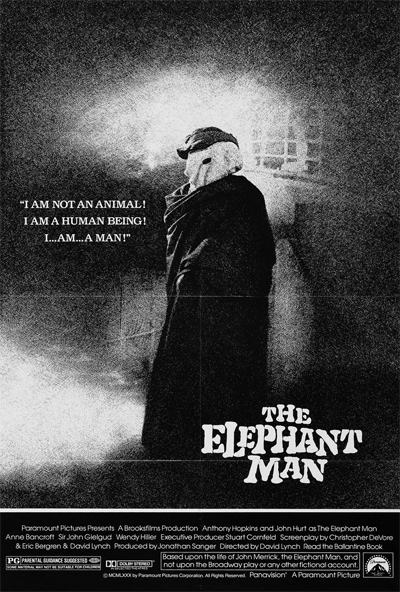
The Elephant Man

In the wake of David Lynch’s unnerving and spellbinding debut feature, Eraserhead, producer Jonathan Sanger (on behalf of Mel Brooks’s production company) turned to Lynch to direct a most distinctive follow up. The Elephant Man (1980) was inspired by the real life of Joseph Merrick, a deformed and ruthlessly exploited man featured in Victorian-era “freak shows.” Upon meeting surgeon Frederick Treves, Merrick found himself hospitalized and in relatively kinder care, but he remained a figure of discomfort and derision for many.
A gentle and creative soul rendered an object of curiosity for both the medical establishment and London high society, Merrick nonetheless carried himself with a dignity captured wonderfully by actor John Hurt. Known previously for I, Claudius and Alien, Hurt brings Merrick to life in a career-defining performance that shines forth despite the incredibly heavy prosthetic makeup required for the part—makeup work that is itself among the film’s technical triumphs. Hurt’s effort is matched by Anthony Hopkins’s deft, measured turn as Treves, alongside a veteran supporting cast including Anne Bancroft and Sir John Gielgud. The film also boasts beautiful black-and-white cinematography by two-time Oscar winner Freddie Francis, who would cap off his career lensing Lynch’s The Straight Story.
Nominated for eight Oscars (but winning none), The Elephant Man won the BAFTA Award for Best Film and Hurt won Best Actor. As one of the late David Lynch’s most accessible movies, it endures precisely because of its insistence on recasting the spectacle of Merrick as a humane exploration of his character—and the character of a society that was hellbent on reducing him to nothing more than that spectacle. Given Lynch’s own background as a Philadelphia-trained artist long before his directing career, it is no surprise that the film can also be viewed as a metaphor for the artistic temperament under siege from oppressive conformity.